
Knowledge center
Focused Shockwaves and Radial Pressure Waves: What Clinics Should Compare Before Buying
These two technologies are generated in different ways and produce different acoustic fields. They are not a premium version and a budget version of the same wave. Focused shockwaves are concentrated in a designated focal zone; radial pressure waves typically have their highest amplitude at the applicator surface and then spread and decay. For clinic procurement, the useful comparison is not “which brochure lists the highest bar or hertz,” but whether the intended use, the measured sound field, the test conditions, the instructions for use, and local authorization actually match the work the clinic wants to do.
This article is a technical briefing for professional buyers. It is not a treatment protocol, not a ranking of devices, and not individual medical advice. AuroraSkin publishes focused and radial device-family overviews, a family comparison, and a procurement FAQ. Those pages describe commercial configurations. They do not replace a model’s instructions for use, acoustic test reports, or destination-market documentation.
1. Start with the names: ESWT, focused shockwaves, and radial pressure waves
In catalogues and in some clinical papers, both technologies are grouped under extracorporeal shockwave therapy (ESWT), and radial systems are often labelled “radial ESWT.” That shorthand is common, but it is easy to over-read. A ballistic radial source produces a diverging pressure wave. In strict acoustic terms, that is not the same event as a focused shockwave. Professional writing therefore does better when it records focused shockwaves and radial pressure waves as distinct modalities, rather than using the umbrella term ESWT alone.
Shockwave therapy is also not the same thing as therapeutic ultrasound, and it is not the same thing as using diagnostic ultrasound to locate a target. Shockwaves are steep, broadband, single pressure transients. Conventional therapeutic ultrasound is a periodic ultrasonic output. Sharing coupling gel, or even a piezoelectric element, does not make the two technologies the same. The hertz value on a shockwave console is a pulse-repetition rate — pulses per second — not an ultrasound carrier frequency in the megahertz range.
For procurement files, the practical habit is simple: write down the generation principle and the field type first, then the model, applicator, and intended use. “Shockwave machine” is too coarse a label for a purchase decision.
2. Generation mechanisms: “electromagnetic” is not a classification by itself
Focused shockwaves are commonly produced in three ways:
- Electrohydraulic. A spark discharge in water creates a pressure pulse, which a reflector then concentrates toward a focus.
- Electromagnetic focused. A coil drives a membrane or diaphragm; a lens or reflector is typically used to form the focus.
- Piezoelectric focused. An array of crystals, or a focusing lens, concentrates the field.
Radial pressure waves are generated differently. A projectile is accelerated along a guide and strikes the applicator. The resulting pressure wave is delivered at the surface and then diverges. The drive that moves the projectile may be compressed air, or it may be electromagnetic. That last point matters, because a brochure that says “electromagnetic” has not yet told the buyer whether the system is a focused membrane device or a ballistic radial handpiece.
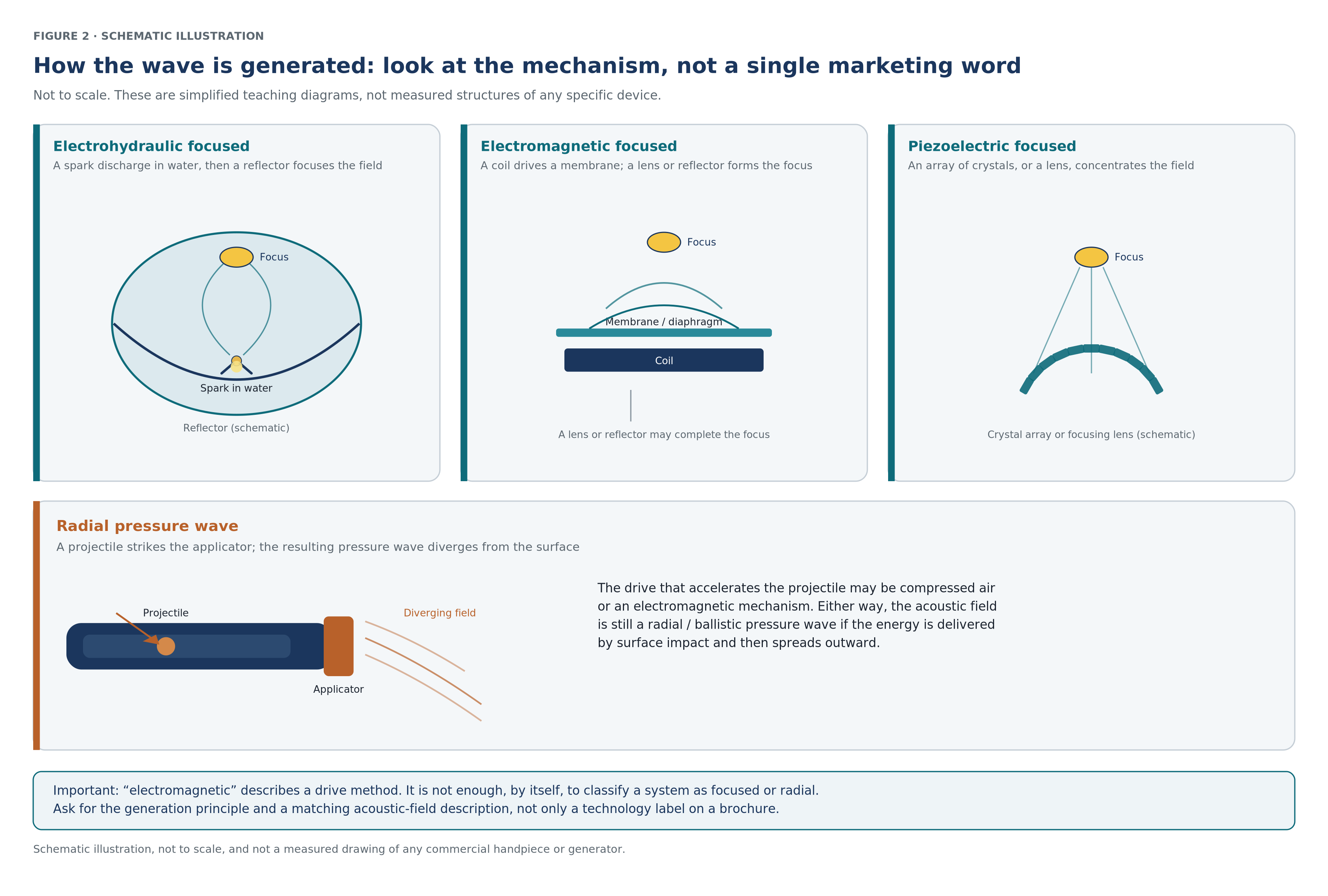
The drawings in Figure 2 are teaching diagrams. They are not exploded views of a particular AuroraSkin system, and they should not be read as a measured internal structure. What the buyer still needs, for any named model, is a clear description of the actual source and a sound-field report that matches that source.
3. Acoustic fields and depth: a focal zone is not a universal number of centimetres
The clinical marketing contrast — “focused goes deep, radial stays shallow” — is directionally familiar, but it is too crude for a purchase file.
In a focused field, energy is concentrated in a designated focal zone. Acoustic energy is also present along the path, not only at the focus. In a typical radial field, amplitude is highest at the applicator surface and then falls as the wave spreads. Neither pattern comes with a single, transferable depth in centimetres. Focal depth and focal dimensions depend on the generator, the geometry, the coupling (including pads or spacers), the output setting, and the tissue path. A water-tank measurement is a laboratory characterisation. It is not, by itself, the dose delivered inside a patient.
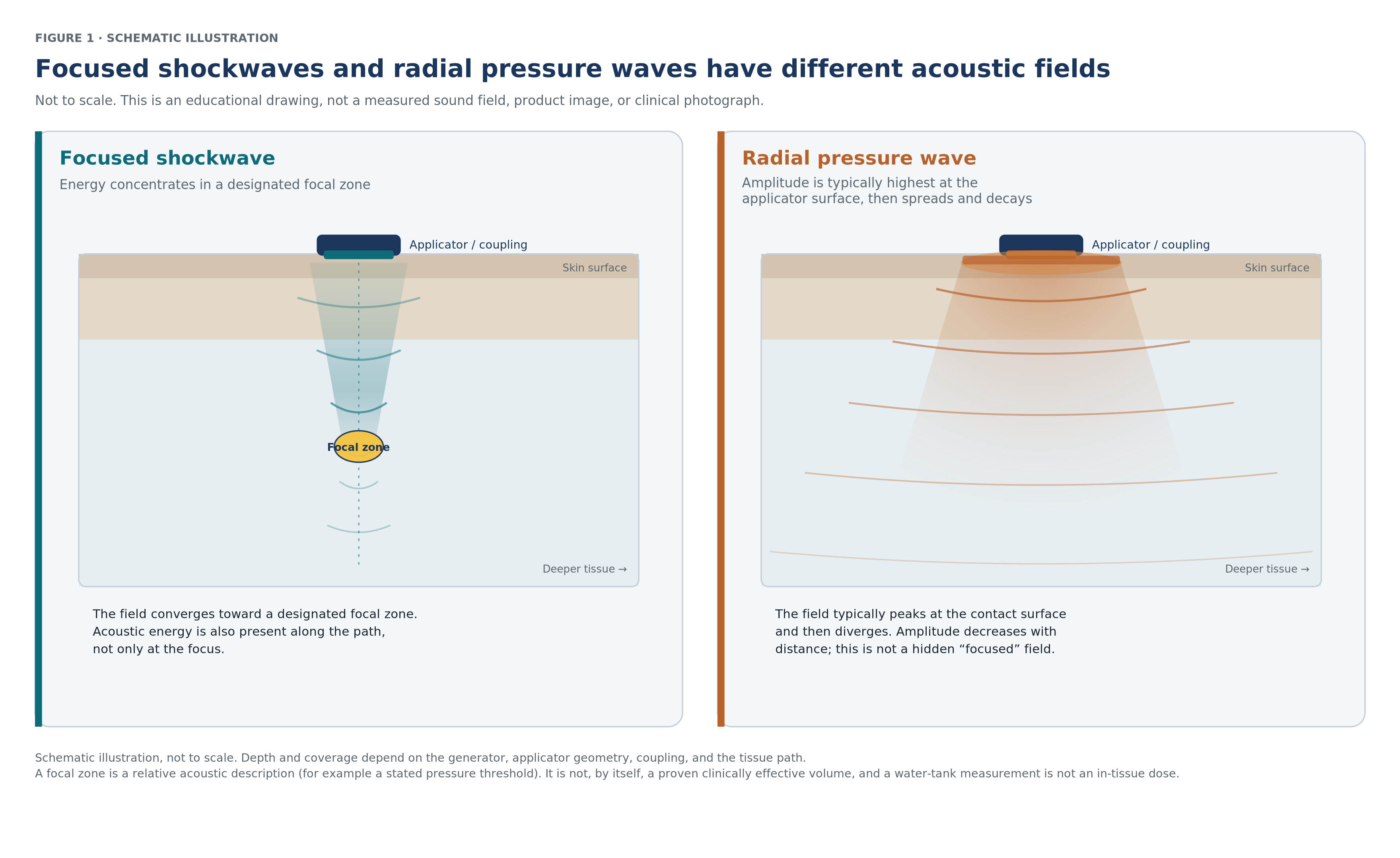
A further caution is easy to miss in brochures. A “−6 dB focal zone,” or any other stated pressure-threshold contour, is a relative acoustic description. It is not automatically a proven clinically effective volume. International measurement standards also distinguish focused pressure-pulse fields from non-focused or weakly focused fields, and the focused-field standard has been revised: IEC 61846:2025 replaces the 1998 edition and, according to the official scope page, widens the older “−6 dB” language to “−n dB” and adds further measurement parameters. Non-focused and weakly focused fields, including ballistic sources, are addressed separately in IEC 63045:2020. This article relies on those official scope and metadata pages; the paid full texts of the standards were not reviewed here. A certificate that simply says “IEC” is therefore not, by itself, evidence that two machines were characterised in the same way, or that a named AuroraSkin model has been shown to conform.
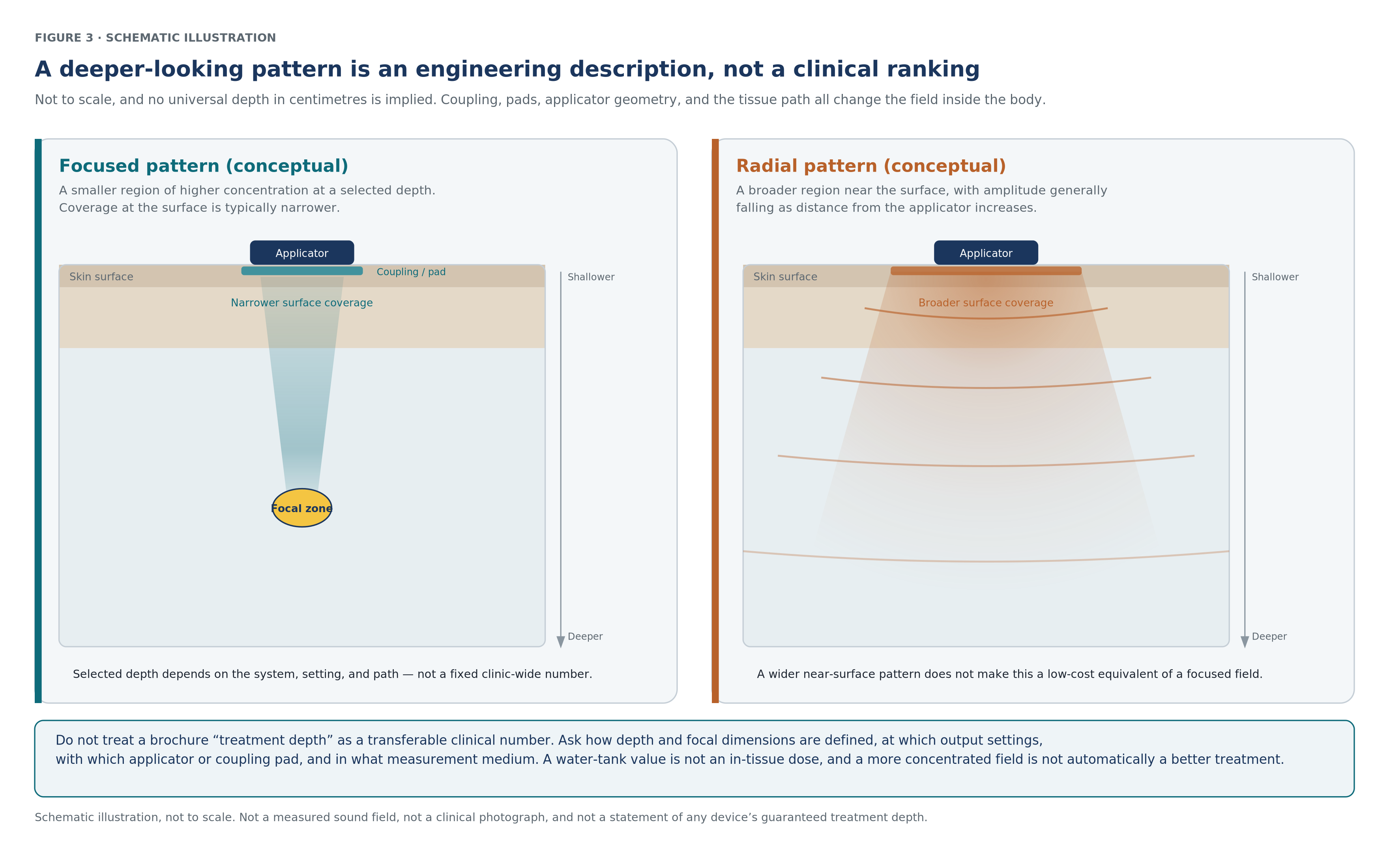
Figure 3 is intentionally qualitative. A more concentrated, deeper-looking pattern is an engineering description. It does not, on its own, prove that the treatment is more advanced or more effective. A broader near-surface pattern likewise does not make a radial system a low-cost equivalent of a focused field.
4. EFD, bar, hertz, and pulse count answer four different questions
Buyers often try to compare devices by lining up a few headline numbers. That only works if the numbers are the same kind of quantity, measured in a stated way.
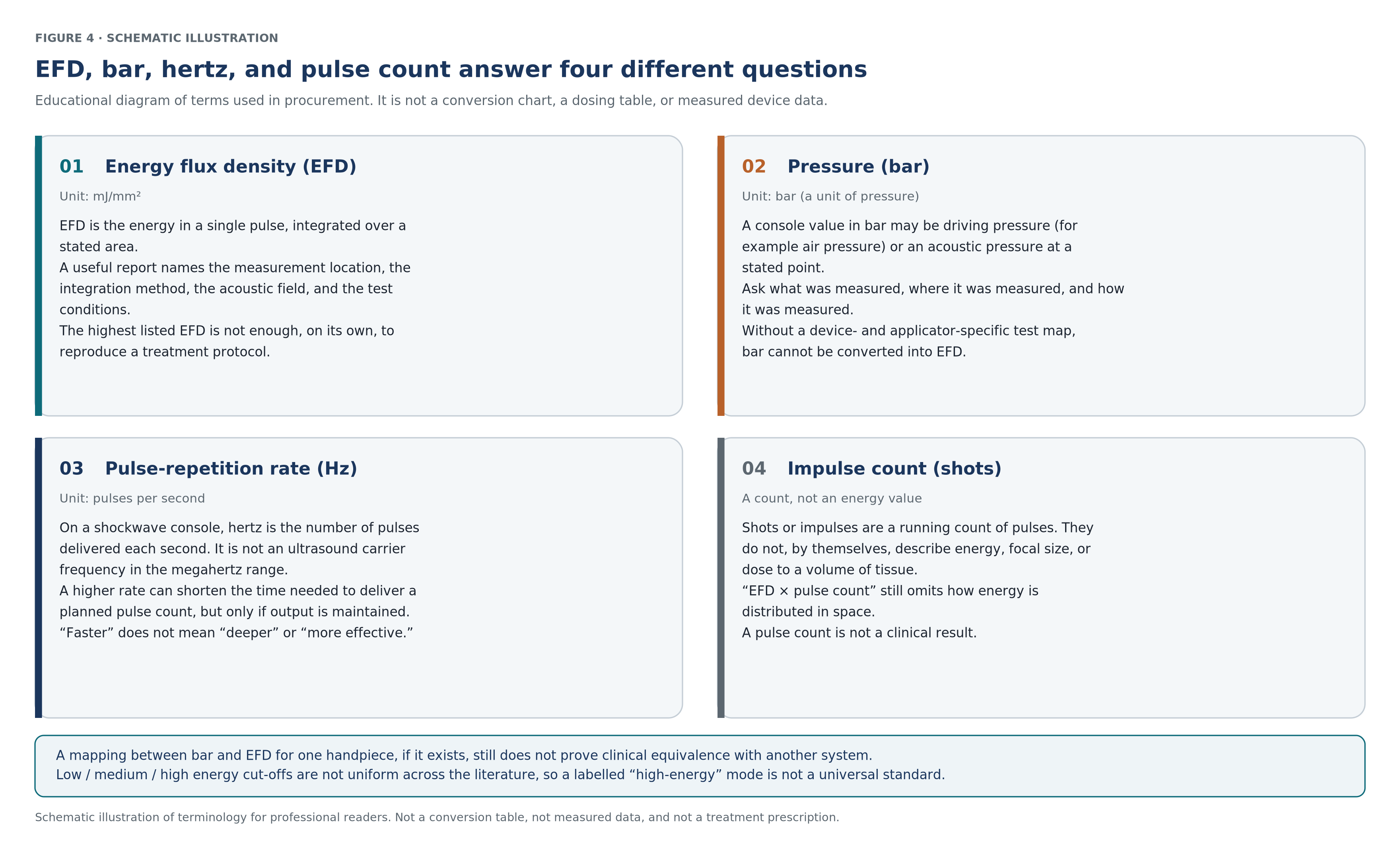
Energy flux density (EFD), in mJ/mm², is the energy in a single pulse, integrated over a stated area. A usable report names the measurement location, the integration method, the acoustic field, and the test conditions. The highest listed EFD is not enough, on its own, to reproduce a protocol.
Bar is a unit of pressure. A number on a console may be driving pressure — for example the air pressure that launches a projectile — or it may be an acoustic pressure at a stated point. Those are not the same measurement. Without a map made on the same device and applicator, under stated conditions, bar cannot be converted into EFD. Even when such a map exists, it does not prove that two systems are clinically equivalent.
Hertz, on a shockwave console, is the pulse-repetition rate: how many pulses are delivered each second. It is not a measure of how “strong” a single pulse is, and it is not an ultrasound carrier frequency. A higher rate can shorten the time needed to deliver a planned pulse count, but only if the intended output is actually maintained, including any thermal or duty-cycle limits. “Faster” does not mean “deeper,” and it does not mean “more effective.”
Impulse count, or shots, is a running total of pulses. It is not an energy value and not a clinical result. Multiplying EFD by the number of pulses still leaves out how energy is distributed in space.
Low, medium, and high energy bands are also less standardized than they look. Cut-offs used in one expert consensus or one paper should not be treated as a global definition, and a mode labelled “high energy” on a screen is not a universal class.
| Question the buyer is asking | Typical unit or record | What it does not tell you |
|---|---|---|
| How much energy is in one pulse, over a stated area? | EFD (mJ/mm²), with location and test conditions | The shape of the field, the in-tissue dose, or the clinical result |
| What pressure is being displayed? | bar, with a definition of driving versus acoustic pressure | An automatic conversion into EFD, or comparability across brands |
| How quickly are pulses being delivered? | Hz (pulses per second) | Penetration depth or effectiveness |
| How many pulses were applied? | Impulse or shot count | Energy, focal size, or patient benefit |
5. Clinical evidence cannot be borrowed across conditions — or across devices
A sound-field difference is a physical fact. A clinical advantage is not. Whether focused or radial treatment helps a particular patient group depends on the condition, the population, the comparator, the waveform and device actually used, the accompanying care, and the follow-up. Results from one indication should not be treated as a general proof that “shockwave works.” Results from one machine should not be treated as evidence for another.
The summaries below are a conservative reading of sources already reviewed for this knowledge base. They are not a new, exhaustive systematic review, and they are not a treatment recommendation.
Plantar fasciopathy: supportive reviews, a negative add-on trial, and an older guideline caution
Some systematic reviews are relatively encouraging. A 2024 systematic review of 11 studies, read here mainly at abstract level, concluded that treatment appeared effective and reasonably well tolerated, while also stating that high-quality research is still needed to establish the best protocol. A 2023 systematic review, also read at abstract level, was likewise comparatively positive for pain and function in plantar fasciopathy, with results that still varied by comparator.
That is not the whole picture. In a 2024 four-arm randomized trial of 200 adults with symptoms lasting more than three months, everyone received advice and custom foot orthoses. Adding radial pressure-wave sessions did not produce an extra benefit over that foundation at the trial’s primary six-month pain outcome; sham treatment and a training programme were likewise no better than the foundation care on the between-group comparison. All groups improved, which is a reminder that within-group change is not the same thing as a treatment-specific effect. A 2025 network meta-analysis of 22 randomized trials, read here only as a PubMed abstract, reported more favourable success rates against placebo, but at low to very low certainty, and it did not find clear differences between energy intensities. Those two studies ask different questions and should be kept side by side, not used to cancel each other in a slogan.
The current NICE page for refractory plantar fasciitis still reflects guidance last reviewed in 2009 and later moved to a new heading number without a fresh evidence review. It reports no major safety concerns, but inconsistent evidence of benefit, and it places use under special arrangements for consent, audit, or research. A later review does not automatically replace a national governance requirement.
Achilles tendinopathy: a 2026 review does not support routine use
This is an area where an older, more optimistic reading should be tightened. A 2025 randomized trial in 76 adults with insertional Achilles tendinopathy found no important extra benefit when radial pressure waves were added to the same education and exercise programme given with sham treatment, at six or twelve weeks. A 2026 systematic review of nine randomized trials (557 participants), read here only as a PubMed abstract, reported no clinically important benefit over sham treatment for insertional disease (low to moderate certainty). For midportion disease, overall pain and disability were not clearly different; a radial subgroup signal of improvement versus sham or wait-and-see was of very low certainty. The abstract did not show a clear advantage for focused over radial treatment, or the reverse. The authors concluded that shockwave therapy should not currently be used as routine treatment for insertional or midportion Achilles tendinopathy. Absence of a clear difference between waveforms is not a formal demonstration that the two are equivalent.
The same 2026 abstract reported two Achilles tendon ruptures after focused treatment. The full paper and event details were not available when this article was prepared, so those cases cannot be turned into an industry-wide rate, and direct causation is not assumed here. They are enough, however, to rule out any claim of “no serious risk.” NICE guidance on Achilles tendinopathy, last reviewed in 2016 and later migrated under a new heading number, likewise describes limited and inconsistent evidence and places use under special arrangements.
Calcific tendinopathy of the shoulder: possible benefit, guideline disagreement, and no crowning of a winner
Professional society guidance has been more supportive of focused or higher-energy treatment for calcific shoulder disease than some national health-technology advice. NICE guidance last reviewed in 2022 reports no major short-term safety concerns, but insufficient evidence of benefit, and it recommends use only in the context of research. Those positions should be shown together, not averaged into a marketing line.
A 2024 systematic review of 21 randomized trials, read here only as a PubMed abstract, reported benefit against sham treatment at some endpoints and some advantage for higher versus lower energy, but rated the certainty of all comparisons as very low; no trial was at overall low risk of bias, and the abstract reported no difference between focused and radial treatment. “No significant difference” is not a formal proof of equivalence. A 2025 network meta-analysis of 33 trials ranked some combined packages highly for pain or function, yet the paper itself reported that pain differences between treatments were not statistically significant. A first-place ranking in a network is not proof that one technology is superior. Image reduction of calcium is also not the same endpoint as a change in pain or function.
Other uses need their own review
Erectile dysfunction, aesthetic claims, wound care, and bone nonunion each require a separate look at the technology, the evidence, the labelled intended use, and local regulatory status. Musculoskeletal studies should not be extended to those areas by analogy. To take only one regulatory illustration: in 2017 the U.S. FDA permitted marketing of a specific system, under a De Novo pathway, for a narrowly defined group of adult chronic full-thickness diabetic foot ulcers, used with standard care. That decision does not authorize other shockwave machines, or other wound types.
Expert consensus is not a substitute for clinical trials. A 2025 international modified Delphi study reached consensus on 69 of 118 statements. The participating experts supported some tendon and fascia applications as an adjunct in multimodal care, and they recommended recording focused shockwaves and radial pressure waves distinctly. The same paper noted that expert opinion and trial evidence are not always aligned, including for insertional Achilles and patellar tendinopathy. A high vote among frequent users is not a patient success rate, and failure to reach consensus on a contraindication is not a safety clearance.
For all of these indications, regulatory identity is model-specific. In the United States, establishment registration or listing is not the same as FDA approval, clearance, or authorization, and FDA does not issue “FDA registered” or “FDA certified” device certificates in the sense often implied in marketing. Approval, clearance, or authorization for one device and one indication does not transfer to AuroraSkin, or to a similar-looking technology, or to a private-label counterpart. This article does not verify the regulatory status of any AuroraSkin model in any market.
6. A procurement checklist: put the comparison into documents
The questions below are a due-diligence list derived from the physical and reporting issues discussed above. They are not a claim that any particular AuroraSkin configuration has already been independently tested in this article.
- What is the exact model, software and hardware version, and legal manufacturer? If the system is relabelled, how does that map to the documented source?
- Is the source focused or radial, and what is the generation principle? If the word “electromagnetic” is used, does it refer to a focused membrane device or to the drive of a ballistic projectile?
- In what medium were pressure or EFD measured, at which points, with which waveform and uncertainty, and against which standard and edition? Is a displayed bar value driving pressure or an acoustic pressure?
- How are focal depth and focal dimensions defined? How do they change with applicator, coupling pad, and output setting? “Maximum treatment depth” without a definition is not a sufficient answer.
- At the highest energy setting, can the highest listed pulse-repetition rate be maintained, and for how long? Are there cooling or duty-cycle limits? If the system has two channels, can they be used together, and do they share power?
- Which applicators are intended for which work? How are they cleaned or disinfected? If a wound-care or veterinary configuration exists, how is it separated from ordinary musculoskeletal use?
- Which parts wear — projectiles, tubes, seals, membranes, or other items? What does a “million-shot” life figure actually refer to, at which settings, and what does replacement cost in time and parts?
- After service, how is output verified? What are the maintenance counters, local service arrangements, and warranty exclusions?
- Are the instructions for use, operator qualifications, contraindications, and incident procedures available for the destination market and language?
- For the intended market, what is the authorization pathway, certificate or listing number, legal holder, model name, and intended use? Registration is not approval. A study should be checked to confirm that it used the same model, applicator, output, and indication now being discussed.
Preset programmes on a console can support workflow. They do not replace diagnosis, a labelled intended use, or a clinician’s judgement.
7. Questions buyers ask
Is focused always better than radial? No. The two fields are different, but clinical superiority has to be shown for a defined condition, device, and comparison. Focused treatment is not automatically better for every problem, and radial treatment is not a cheaper equivalent of the same field.
If a device is electromagnetic, is it focused? Not necessarily. Electromagnetic drive is used in some focused systems and can also be used to launch a projectile in a radial system. Ask for the generation principle and the sound-field description.
Can I convert bar into mJ/mm²? Not from the units alone. That conversion requires a measurement on the specific device and applicator, under stated conditions. Even then, the mapping is not proof of clinical equivalence with another system.
Does a higher hertz setting treat deeper or work better? Hertz is the pulse-repetition rate. It is not a depth setting and not a clinical-outcome guarantee. Whether a high rate can be sustained at a given energy level is a question for the manufacturer’s measurements.
Can these devices be sold for unsupervised home use? That should not be assumed for professional systems. AuroraSkin’s public FAQ states that its ESWT devices are intended for professional settings and trained therapists. The labelled use, the instructions for use, and local rules still govern any specific model.
If a device is “FDA registered,” can it be promoted as FDA approved for pain or other uses? No. Registration or listing is not approval, clearance, or authorization. Any U.S. claim has to match the actual pathway and the specific intended use of that model. The same caution applies in other markets: ask for the current documents rather than a generic badge.
Is treatment painless and free of side effects? No. Local pain, redness, bruising, and swelling are among the effects described in professional sources. More serious events have been reported in the literature, sometimes with uncertain causality. Screening, consent, and the model’s instructions for use are part of responsible use. “No major safety concerns” in a health-technology assessment is not the same as “no side effects.”
Closing
Clinics comparing focused shockwaves and radial pressure waves are comparing two different physical methods, not two trim levels of one product. The sound fields differ, the parameters are not interchangeable, and the clinical literature has to be read by condition, comparator, and follow-up. Some uses have mixed or encouraging evidence; others, including routine treatment of Achilles tendinopathy, are not supported by the more recent reviews summarized here. None of that is a reason to over-claim, and none of it is a substitute for model-specific technical files.
If you are reviewing AuroraSkin systems for a clinic or a distribution market, request the documents that belong to the exact configuration and destination, rather than relying on a general technology article. The contact page is the public route for that request.
Disclaimer
Related pages
- Focused shockwave family overview
- Radial shockwave family overview
- Device-family comparison
- FAQ
- Contact
- About
- Home
References
Access dates below come from the source review that underlies this article. A later heading-number change on a government site is not treated as a new evidence review. Sources marked “abstract only” were not read in full.
- International Society for Medical Shockwave Treatment (ISMST) / DIGEST. Guidelines for Extracorporeal Shock Wave Therapy. Document dated 20 July 2023 (Daegu); file path dated 3 January 2024. PDF, 114 pages, read in extract. https://shockwavetherapy.org/wp-content/uploads/2024/01/ISMST-Guidelines-for-ESWT-_-engl-20240103.pdf. Professional-society guidance, not a regulatory approval. Some indication chapters are more positive than later trial evidence or NICE advice and are not used here as proof of efficacy.
- Tenforde et al. Best practices for extracorporeal shockwave therapy in musculoskeletal medicine. PM&R. 2022. Narrative / professional-practice review; full text read. https://pmc.ncbi.nlm.nih.gov/articles/PMC9321712/. DOI: 10.1002/pmrj.12790. Author recommendations are not a substitute for a model’s instructions for use, and mechanism discussions are not product-efficacy evidence.
- de Menezes et al. How to report parameters and procedures for shockwave therapy in musculoskeletal disorders? 2022. Narrative / expert-consensus reporting review; full text used for the reporting framework. https://pmc.ncbi.nlm.nih.gov/articles/PMC9371498/. The paper argues for better parameter reporting; it does not provide a universal bar-to-EFD conversion. A simplified remark in that literature about frequency and depth is not adopted here as a cross-device rule.
- Lippi et al. Efficacy and tolerability of extracorporeal shock wave therapy in patients with plantar fasciopathy: a systematic review with meta-analysis and meta-regression. European Journal of Physical and Rehabilitation Medicine. 2024;60(5):832–846. Systematic review (11 studies; search to February 2023). Abstract mainly; full text not claimed. https://pubmed.ncbi.nlm.nih.gov/39257331/. Open-access entry also: https://pmc.ncbi.nlm.nih.gov/articles/PMC11561739/. Pooled change in a review should not be read as a net effect versus placebo, and a meta-regression is not a dosing rule.
- The effectiveness of shockwave therapy on patellar tendinopathy, Achilles tendinopathy, and plantar fasciitis: a systematic review and meta-analysis. 2023 (search to 14 December 2022). Abstract only. https://pubmed.ncbi.nlm.nih.gov/37662911/. Findings differ by condition and comparator; the authors’ internal GRADE labels are not treated here as a field-wide certainty rating.
- National Institute for Health and Care Excellence (NICE). Extracorporeal shockwave therapy for refractory plantar fasciitis. HTG200 (formerly IPG311). Last reviewed 26 August 2009; later number migration is not a 2026 evidence update. https://www.nice.org.uk/guidance/htg200; recommendations: https://www.nice.org.uk/guidance/htg200/chapter/1-recommendations.
- NICE. Extracorporeal shockwave therapy for calcific tendinopathy in the shoulder. HTG645 (formerly IPG742). Last reviewed 9 November 2022. https://www.nice.org.uk/guidance/htg645; recommendations: https://www.nice.org.uk/guidance/htg645/chapter/1-Recommendations.
- NICE. Extracorporeal shockwave therapy for Achilles tendinopathy. HTG426 (formerly IPG571). Last reviewed 21 December 2016; later number migration is not a new review. https://www.nice.org.uk/guidance/htg426; recommendations: https://www.nice.org.uk/guidance/htg426/chapter/1-Recommendations.
- Rhim et al. Recommendations for use of extracorporeal shockwave therapy in sports medicine: an international modified Delphi study. British Journal of Sports Medicine. 2025;59(18):1287. Expert consensus (41 experts, 13 countries; 69 of 118 statements reached consensus), not a randomized trial. Key sections of the accessible full text were read; not every appendix table was reviewed. https://bjsm.bmj.com/content/59/18/1287. DOI: 10.1136/bjsports-2024-109082. Consensus is not efficacy, and energy cut-offs used in that paper are not a global standard.
- Heide M, et al. Is radial extracorporeal shock wave therapy (rESWT), sham-rESWT or a standardised exercise programme in combination with advice plus customised foot orthoses more effective than advice plus customised foot orthoses alone in the treatment of plantar fasciopathy? A double-blind, randomised, sham-controlled trial. British Journal of Sports Medicine. 2024;58(16):910. Randomized trial, n = 200; methods, primary and secondary results, and limitations in the accessible text were read. https://bjsm.bmj.com/content/58/16/910. Registration: NCT03472989. This is an add-on trial on top of advice and custom orthoses, not a verdict on every plantar-fasciopathy setting.
- Alsulaimani B, et al. Does shockwave therapy lead to better pain and function than sham over 12 weeks in people with insertional Achilles tendinopathy? A randomised controlled trial. Clinical Rehabilitation. 2025;39(2):174–186. Randomized trial, n = 76; open full text via PMC was read. https://pmc.ncbi.nlm.nih.gov/articles/PMC11846266/. DOI: 10.1177/02692155241295683. Single-centre, 12-week follow-up; the treating clinician was not blinded. Some pressure and energy reporting in the paper is internally inconsistent, so its estimated EFD is not used here as a conversion standard. Results do not automatically extend to midportion disease or to other waveforms.
- Brindisino et al. The effectiveness of extracorporeal shock wave therapy for rotator cuff calcific tendinopathy. A systematic review with meta-analysis. 2024 (search to February 2024). 21 randomized trials. Abstract only; full text and forest plots not reviewed. https://pubmed.ncbi.nlm.nih.gov/38878302/. DOI: 10.1002/pri.2106. All comparisons were of very low certainty. “No difference” between focused and radial treatment is not a formal equivalence finding and does not overwrite NICE’s research-only position.
- Zhao et al. Comparative efficacy and acceptability of different intensity levels of extracorporeal shock wave therapy in adults with plantar heel pain: a systematic review and network meta-analysis. PM&R. 2025 (search to March 2024). 22 randomized trials, 2,299 participants. Abstract only; journal page timed out and was not read in full. https://pubmed.ncbi.nlm.nih.gov/40709373/. DOI: 10.1002/pmrj.13417. Certainty was low to very low. Odds ratios are not success probabilities and should not be turned into marketing percentages.
- Yao Y, et al. (Yuming Yao and Guang Yang contributed equally). Treatments for rotator cuff calcific tendinitis: a systematic review and network meta-analysis of randomized-controlled trials. EFORT Open Reviews. 2025;10(7):520. 33 randomized trials, 2,102 participants; search actually ended 10 October 2023. Key sections of the accessible full text were read. https://journals.bioscientifica.com/eor/article/10/7/520/1753/Treatments-for-rotator-cuff-calcific-tendinitis-a. DOI: 10.1530/EOR-2024-0078. Network rankings are not the same as statistically significant superiority; some comparisons rely on indirect evidence.
- Shockwave therapy for midportion and insertional Achilles tendinopathy: a systematic review and meta-analysis. Journal of Orthopaedic & Sports Physical Therapy. 2026;56(5):282–299. Online 27 March 2026. 9 randomized trials, 557 participants. Abstract only; the journal page returned HTTP 403 and the full text was not obtained. https://pubmed.ncbi.nlm.nih.gov/42063301/. DOI: 10.2519/jospt.2026.13985. The article title is not treated as a final verdict on every shockwave use. Sample overlap with the 2025 insertional trial is possible; the two should not be added as if they were independent populations.
- U.S. Food and Drug Administration. FDA permits marketing of device to treat diabetic foot ulcers. 28 December 2017. Official De Novo marketing-authorization announcement for a specific system and a narrowly defined wound indication. https://www.fda.gov/news-events/press-announcements/fda-permits-marketing-device-treat-diabetic-foot-ulcers. This is not an authorization for other machines or other uses, and it is not an AuroraSkin approval.
- U.S. Food and Drug Administration. Are there FDA-registered or FDA-certified medical devices? How do I know what is FDA approved? Consumer explainer; no clear page date was visible at the last knowledge-base review. https://www.fda.gov/medical-devices/consumers-medical-devices/are-there-fda-registered-or-fda-certified-medical-devices-how-do-i-know-what-fda-approved. Registration or listing is not approval, clearance, or authorization.
- International Electrotechnical Commission. IEC 61846:2025, edition 2.0, published 30 January 2025. Official product page describing characterisation of focused pressure-pulse fields (exact full standard title not restated here because the paid text was not obtained). Scope and revision notes only; paid 80-page standard not obtained. https://webstore.iec.ch/en/publication/72095. Cited here for the existence of an updated focused-field standard and for due-diligence questions, not as proof that any product conforms.
- International Electrotechnical Commission. IEC 63045:2020, non-focused or weakly focused pressure-pulse fields, edition 1.0, published 25 May 2020. Official scope and metadata only; paid 61-page standard not obtained. https://webstore.iec.ch/en/publication/29645. A ballistic source may fall under this family of measurements; that is not a clinical clearance.
- European Association of Urology. Sexual and Reproductive Health guidelines, erectile-dysfunction chapter, 2026 edition. https://uroweb.org/guidelines/sexual-and-reproductivehealth/chapter/management-of-erectile-dysfunction; 2026 changes: https://uroweb.org/guidelines/sexual-and-reproductive-health/summary-of-changes/2026. Weak recommendation in defined vascular ED populations; most trials used focused shockwaves, and one radial randomized trial was reported as no better than sham. This is not a U.S. regulatory authorization and not advice for an individual patient.
---